Making Marks
There’s something deeply honest about a mark made without overthinking.
A wobbly line, an unintended splash, a scrape, a drag, a pause.
These moments tell the real story of how I move through a landscape, how I feel in a place, how present I allow myself to be. Mark making, for me, has never been about decoration. It’s communication. It’s how I translate the experience of being outdoors, with the wind, the sky, the tangle of grasses underfoot — into something visual. And the more I’ve learned to let go of control, the more alive those marks have become.
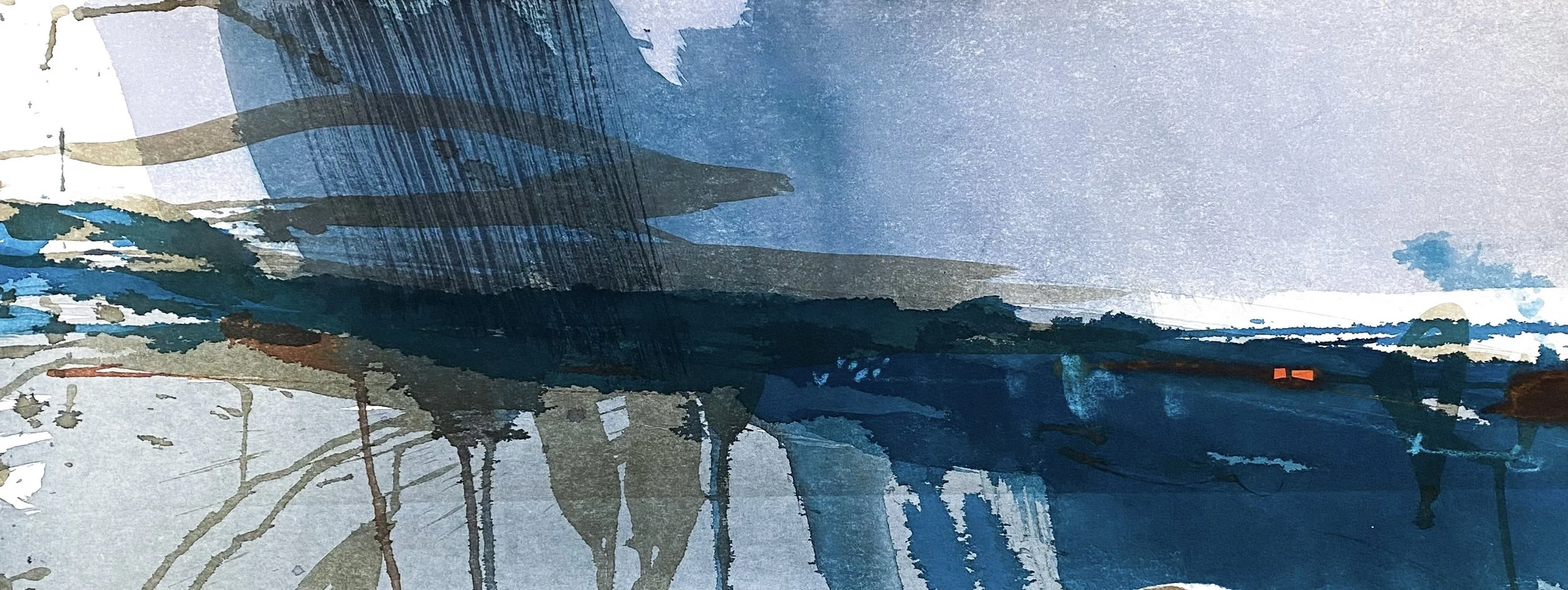
Storm Over Estuary
Moving Beyond Description
When we first learn to draw and paint, we’re often taught to describe what we see as accurately as possible. This stage matters — it gives us the foundations we need. But at some point, for some of us, realism can begin to feel restrictive.
Leaves don’t need to look like leaves. Grasses don’t need to be individually drawn. Clouds don’t need neat edges. Instead, they can be suggested. A cluster of quick, energetic lines can hold more truth than careful detail.
A loose wash can carry the weight of a sky far better than a perfectly blended gradient. Mark making allows us to hint rather than explain — and that’s where expression begins.
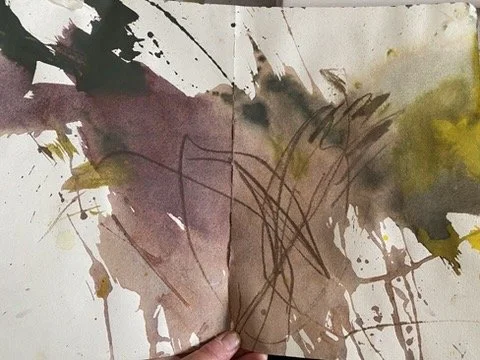
Making marks
Playing with inks and pastels
Fear, Mess and Freedom
One of the biggest barriers I see when working with other artists is fear. Fear of making a mess. Fear of wasting paper. Fear of creating something that feels unfinished or wrong. But expressive mark making requires mess.
It asks you to trust that not every mark needs to be resolved, and that not every page needs to be precious. When you push past that initial discomfort, something shifts. Your marks become bolder. Your hand loosens. Your work starts to carry your personality. This isn’t about being reckless — it’s about being responsive.
Responsive Drawing
Some of my most important breakthroughs came when I stopped standing still. Walking, sketching, responding on the move — drawing what caught my attention rather than what felt ‘correct’.
Marks gathered from different angles, different moments, layered together into something that felt far more truthful than a single fixed viewpoint. Responsive drawing changes how you see. You begin to notice textures instead of objects.
Movement instead of outlines. Tone and contrast instead of colour. And slowly, almost without realising it, your marks start to do the heavy lifting for you.
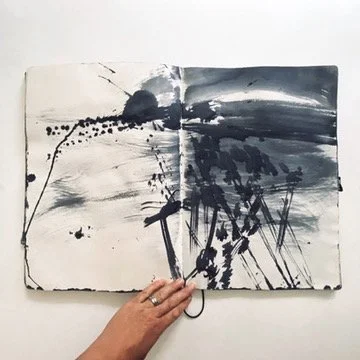
One of my sketchbook spreads
Less Tools, More Voice
It’s tempting to think better work comes from more materials. In reality, it’s often the opposite. By stripping back your kit — one drawing tool, one fluid medium — you remove distraction.
You begin to understand what you do with a line.
How pressure changes it.
How speed affects it.
How tone creates depth and focus.
This is where a painterly voice starts to emerge. Not from abundance, but from limitation!
I hope this helped give you some ideas and support on your unique artistic journey!
Stay wild & free,
Sam x