Part 3 - Become a Composer, not a Copier!
Why abstract composition isn't guesswork — and how thinking like a musician rather than a documentarian will transform the way you work in the landscape.
Welcome to part three of my six-part series on abstraction. We've explored the fear of letting go of recognisable forms, and the grip of over-attachment to detail. In this episode we're moving into territory that trips up even experienced artists: composition.
Because when the horizon line disappears and the familiar anchors fall away, how do you know what you're doing? How do you know if it's working? How do you even begin?
So let’s start with some simple prompts for you to think about. Do these sound familiar to you?
Without representational elements, composition feels like guesswork.
I don't know what to paint if I don't have a real focal point to anchor me.
When I go more abstract, it just looks messy and confusing — and I can't tell what's working.
I understand the rules of traditional composition. But abstract feels like there are no rules at all.
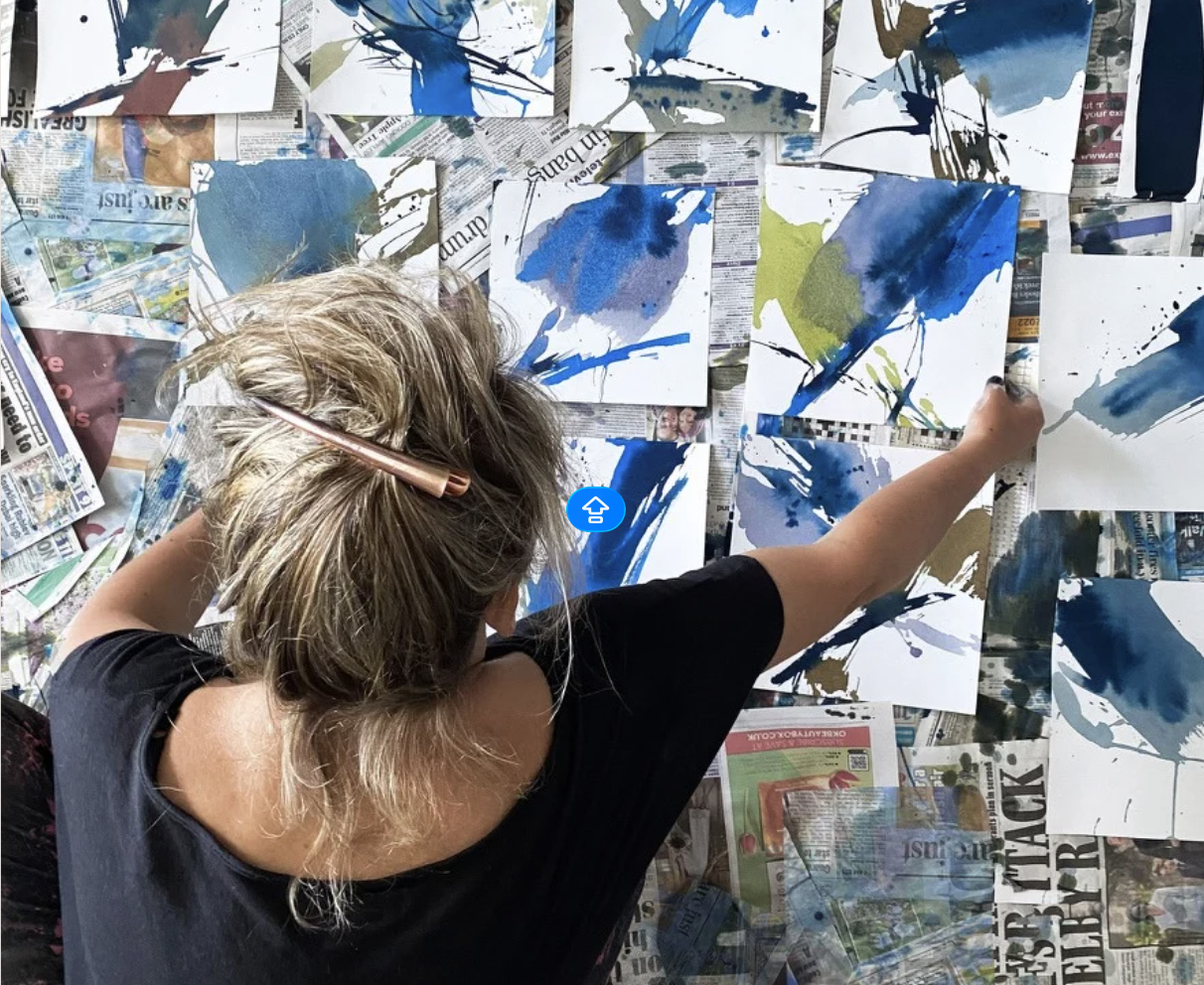
I absolutely get it. And I want to be honest with you: this is genuinely hard. When you paint a scene with a tree, a horizon, rocks, and sea, the composition almost arranges itself. There is an understood visual order. The eye knows where to go. You are copying what you see — and the seen world provides a ready-made structure.
But the moment you move toward abstraction, that scaffolding falls away. And if you've spent years relying on it, the first few times you paint without it can feel vertiginous. Unmoored. As if you're not making art at all — just making marks that don't add up to anything.
The answer isn't to find a new set of rules to replace the old ones. The answer is to change the metaphor you're working from entirely.
From copying to composing
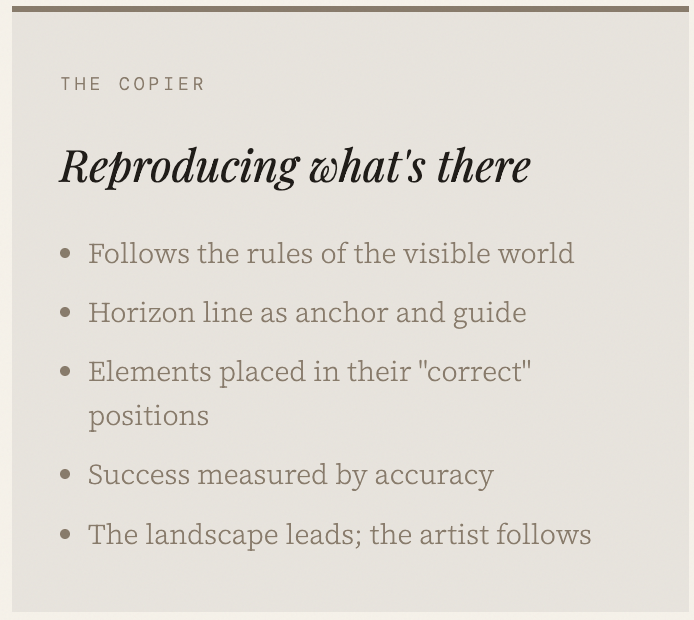
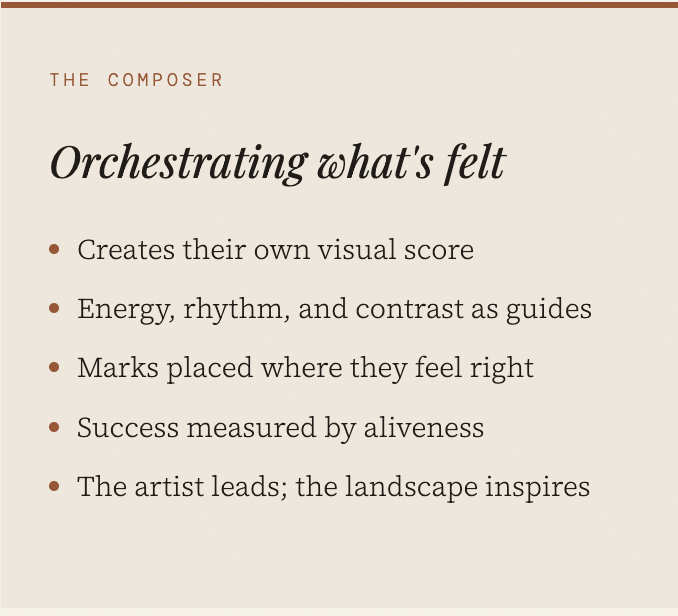
Think of a composer sitting at a piano. They are not trying to reproduce the sound of a thunderstorm note for note, frequency for frequency. They are listening to its character — the sudden crack of it, the rolling distance, the electricity in the air before it breaks — and they are translating that into musical language. Into rhythm and weight and dynamics and silence.
That is exactly what you are doing when you paint the landscape abstractly. You are not copying. You are composing. You are taking the raw material of what you see and feel, and arranging it into your own visual score — using marks, textures, tones, and colours the way a musician uses notes.
Think of your marks like music notes. You are the conductor — playing with a collection of textures and colours, dynamics and silences, bold passages and delicate ones. There is no right or wrong. Only play, and instinct.
The elements of your visual score
Every piece of music has dynamics — the interplay between loud and soft, fast and slow, dense and sparse. Your paintings have exactly the same. Once you start thinking in these terms, the confusion of abstract composition begins to lift. You're not lost. You're just learning a new language.
YOUR PALETTE OF DYNAMICS
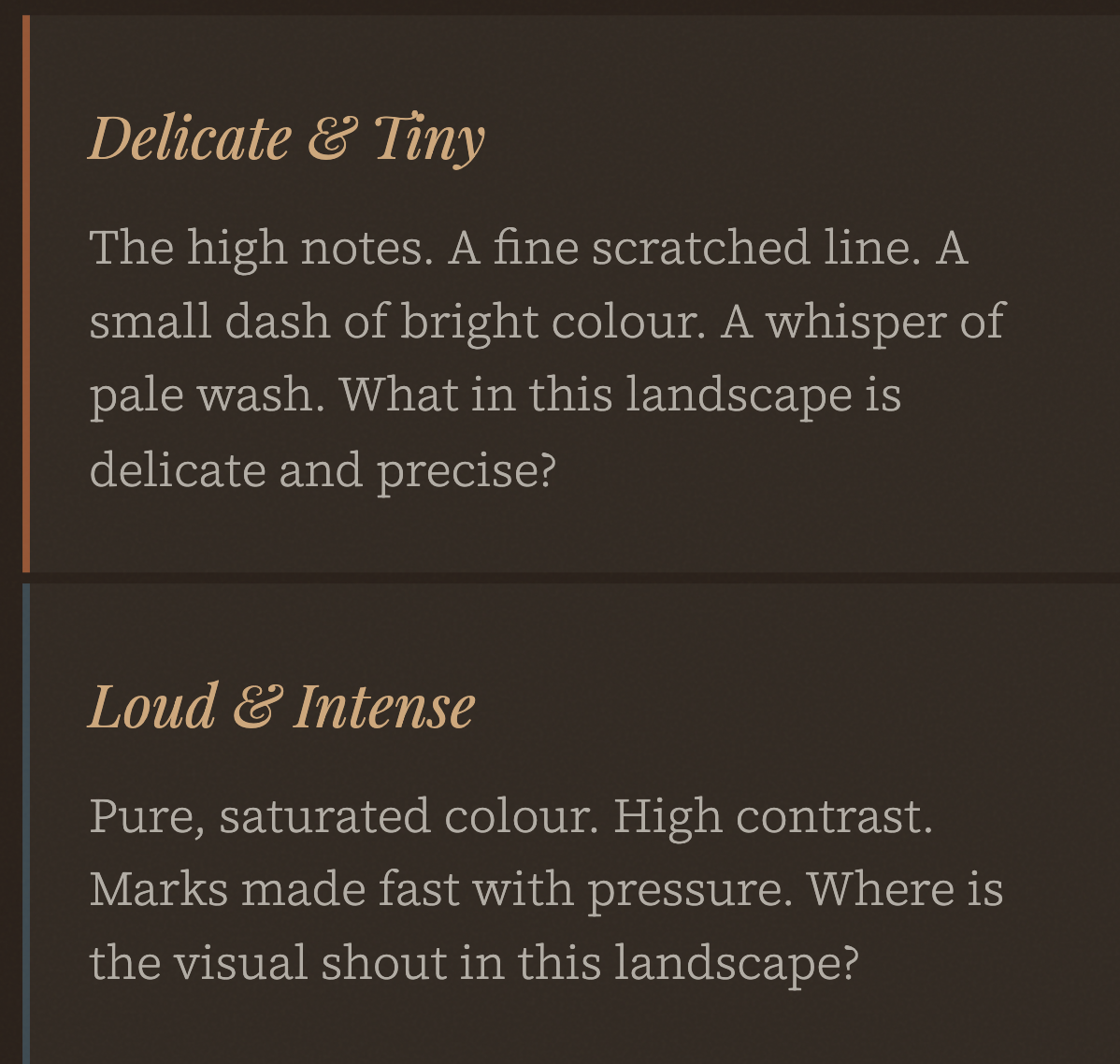
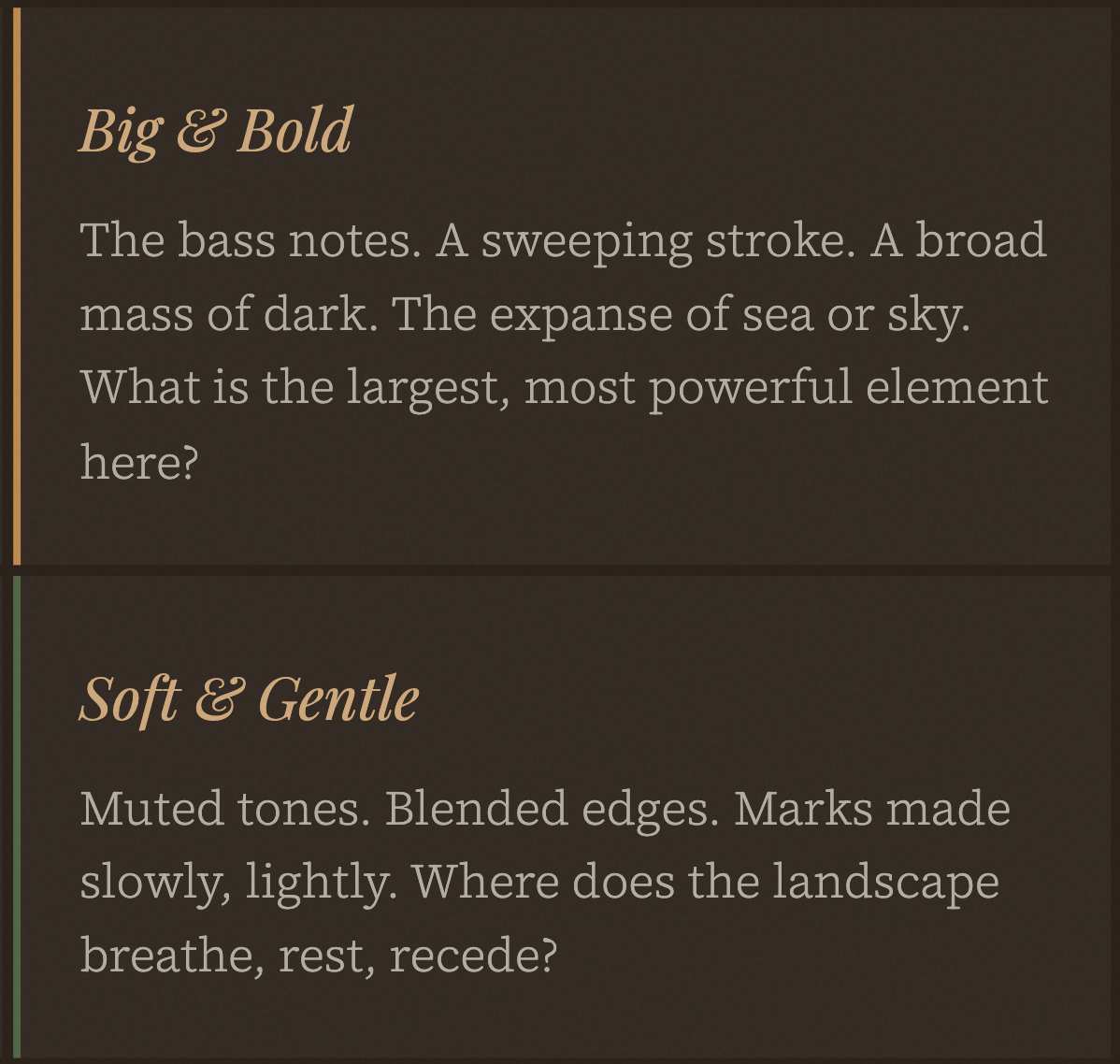
Notice that none of these elements require a horizon line. None of them require anything to be in its "correct" position. They are entirely about the relationship between marks — about contrast, rhythm, weight, and energy. And those qualities exist in every landscape you will ever stand in front of.
The more you think in these terms, the more you'll realise that abstract composition is not the absence of structure. It is a different kind of structure — one built from feeling and rhythm rather than from correct placement of recognisable things.
An exercise in imagination — before you even touch the paper
You are outside on a windy day. Leaves are rustling and lifting. Birds are circling in wide arcs above you. The clouds are racing — you can almost feel the sky moving. The air has that electric charge that comes before something changes. In your hand: a sketchbook and a soft pencil.
How will you draw this? Static and safe — a careful horizon, trees placed just so, clouds outlined neatly? Will that approach carry even a fraction of what this moment actually feels like?
Or: what if you scribbled and rubbed? What if you introduced another medium to splash? What if you reached for a big brush to swipe and stroke? What if the marks themselves became the wind?
An exercise to find your compositional instinct
This exercise is designed to help you stop thinking about composition as placement — where things go — and start feeling it as orchestration: the interplay of marks, tones, and energies across the surface.
Exercise
Fast Landscape Studies — Capture Energy, Not Horizons
Take a soft pencil, charcoal, or another expressive drawing medium — avoid hard HB pencils, which encourage precision rather than flow — and go outside to make quick studies. Your mission is not to record what you see. It is to capture how it feels.
Begin with sky: what are the first marks that could suggest clouds? Dark and stormy or soft and drifting?
Move to what's below: trees, grasses, fields. How are they moving? Make a mark that suggests that movement rather than naming it.
Vary the pressure: hard for weight and energy, light for atmosphere and distance.
Ask yourself: what are the HIGH notes of this place — the delicate, fine things? What are the deep BASE notes — the heavy, vast, grounded things?
There is no right or wrong.
Only play, and instinct, and the marks you make.
As you work through the exercise, you may find the instinct arrives gradually — a quiet sense that this arrangement has something, that this mark belongs where it landed. That is your compositional voice beginning to speak. It has always been there. You are simply learning to hear it without the noise of rules and correctness drowning it out. The landscape will always give you material. Your job — as the composer — is to decide what to do with it.
Coming next in this series
PART 4 — Mindset & Perfectionism in Abstract Painting
I hope the composer idea opens something up for you this week — it's a metaphor I return to constantly in my own practice. Next time you stand in front of the landscape with a brush in your hand, try asking yourself: what score am I writing here? What are the high notes? Where is the bass?
Trust your instinct. Play with your notes. The composition will come.
Love Sam x