Part 4 - Mindset and Perfectionism
The mindset shift that unlocks abstract painting — and why your messy, confused, unresolved work might be your most honest work of all.
Welcome to week four of my six-part series on abstraction. Over the last three episodes we've looked at the fear of losing recognisable forms, the grip of over-attachment to detail, and how to think like a composer rather than a copier. This week we go to the heart of it all — the thing that underpins every single one of those struggles. Mindset. Specifically: the perfectionism that wants the painting to be good before it even exists.
As a semi-abstract artist, I know from the inside how mysterious and tricky abstract painting can feel — especially if your natural practice leans toward a more traditional approach. When we paint what we know, in ways that others recognise and understand, there is a kind of safety in it. An understood contract between painter and viewer. The rules are shared.
Abstract painting breaks that contract. And the moment it does, a very particular fear rushes in to fill the gap.
"Perfectionism stops me from beginning. I want it to be good before it even exists."— A Wild at Art member
That line stopped me when I read it. Because it describes something so precisely — the way perfectionism doesn't just intervene in the middle of the work, or at the end when you step back and judge. It intervenes before the first mark. It turns the blank surface into an examination before you've even sat down.
The worry of making it good, making it accepted, making it correct — that worry doesn't just create anxiety. It kills spontaneity outright. And spontaneity is the very thing abstract painting runs on.
Abstract art is fluid, uncertain, and deeply expressive. That is not its weakness — that is its power. Learning to trust the process, and to trust yourself within it, is the whole work.
The single most important mindset shift
Here it is: stop treating abstract painting as performance, and start treating it as discovery.
When you perform, you already know what the result should look like. You are trying to achieve something predetermined — something that will be judged, accepted, seen. The blank canvas becomes a stage and you are acutely aware of the audience, real or imagined.
When you discover, you genuinely don't know what's coming. You are testing, trying, following instinct, making mistakes, and learning from them. The blank canvas is not a stage — it is a laboratory. And in a laboratory, a failed experiment isn't a failure. It's data.
You are meant to make a mess. You need to make mistakes. These are not signs that you're doing it wrong — they are the process itself.
THE SHIFT IN YOUR PRACTICE
From "Will this be good?" to "What will I find?"
I need to know what I'm making before I begin → I'll begin, and find out what it wants to become
If it looks a mess, I've failed → The mess is where the discovery lives
I need others to understand it →I need it to be honest — understanding can come later
Getting it wrong means I'm not good enough →Getting it wrong means I'm learning. That is enough.
What the sketchbook taught me
I want to share something honest about my own practice, because I think it matters.

Sam's sketchbook confession
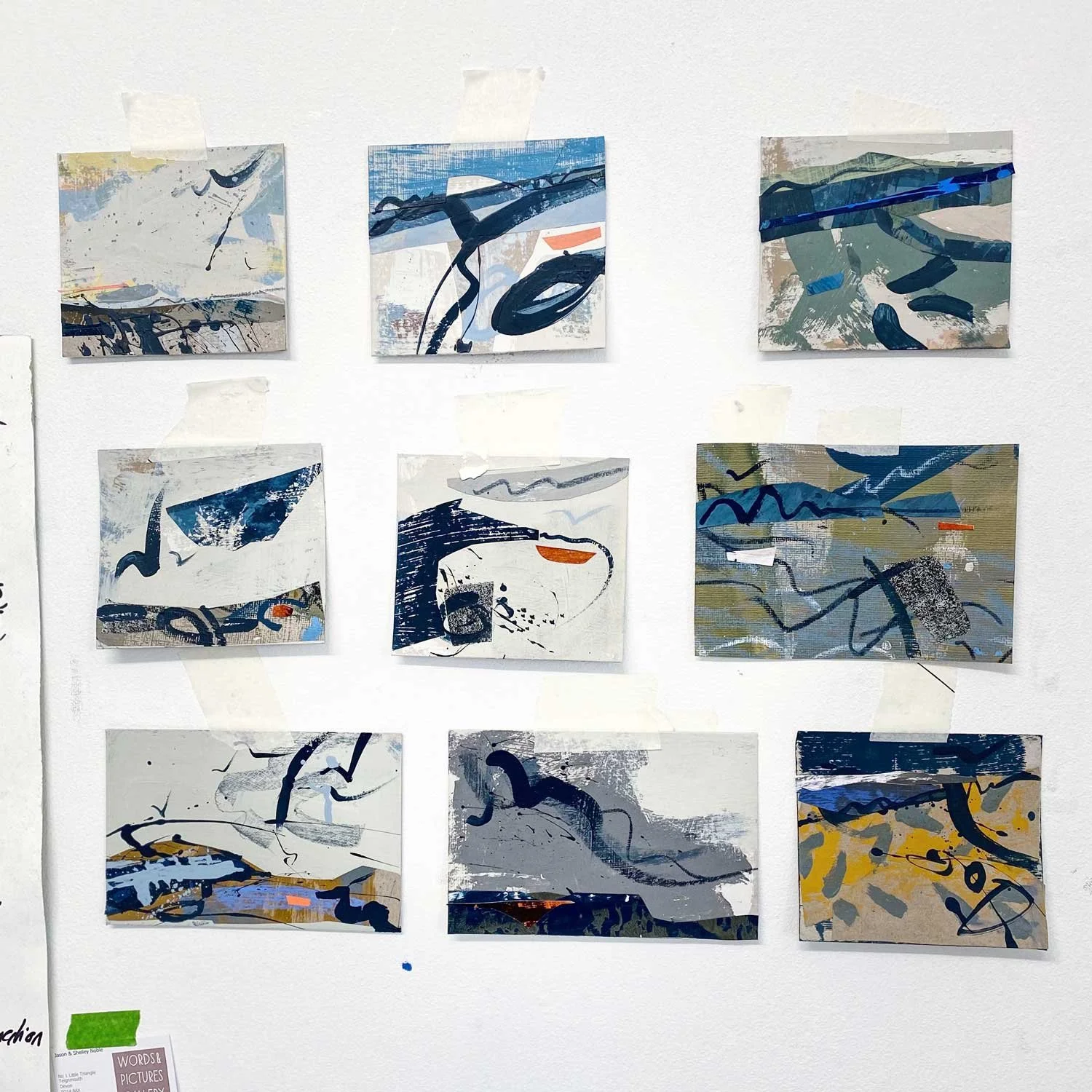
My sketchbooks contain some of my very best work. They also contain pages I'd genuinely prefer to tear out. Big blocks of awful. Messy, confusing washes of muddy colour. Pages where I can't decipher what it was meant to be, where I even was, or what I was thinking.
But here's the thing: I have no fear when I work in my sketchbooks. Making good art is never the goal. The purpose is to experiment and learn. And it is precisely because of that mindset — that openness to discovery, that complete lack of performance anxiety — that they contain such raw, honest landscape studies.
The sketchbook doesn't care if you're good. And so you get to find out what you actually are.
The question worth sitting with is this: what would happen if you brought that same sketchbook energy to your studio work? Not recklessness — but that genuine openness. That willingness to not know. That permission to find out.
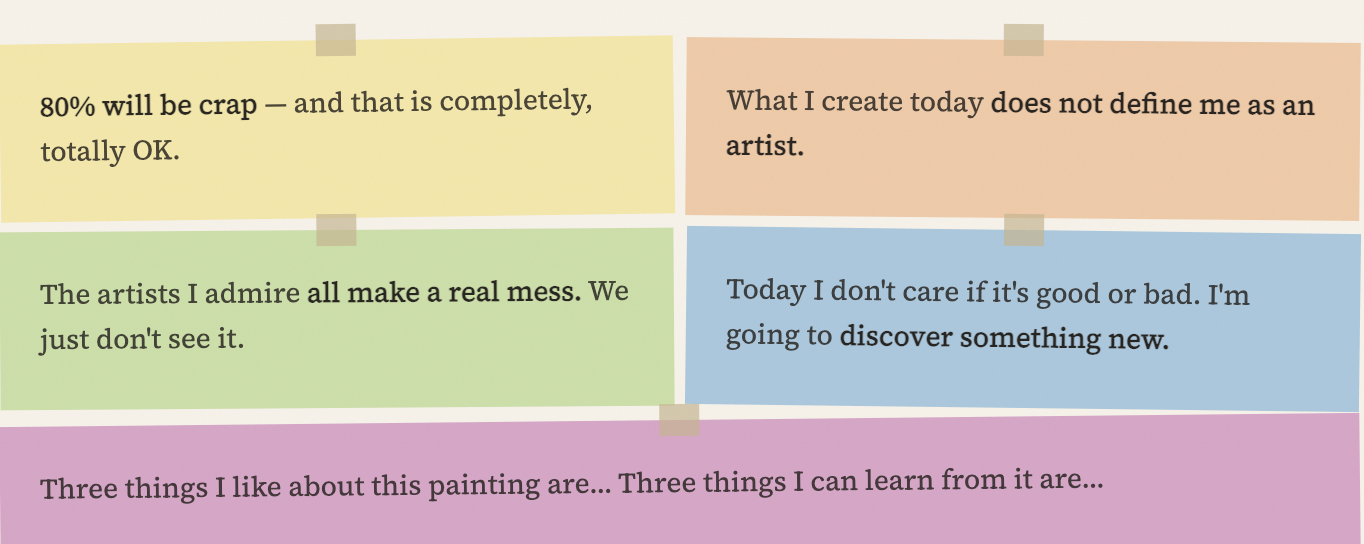
Five notes to stick on your studio wall
Before we get to the exercises, here's one of the simplest and most effective things you can do. Write these on sticky notes or scraps of paper and pin them up where you work. Not as mantras to recite — but as quiet, practical reminders for the moments when the perfectionist voice gets loud.
An experiment in creative freedom.
Exercise
Create 5 Versions — and Push Each One Further
Take a landscape study you already like — something that has some life in it — and make five versions of it. The goal with each version is to take it a step further from the literal. Looser. More abstract. More simplified. More suggestive.
Version 1: close to the original in feel but more loosely made
Version 2: simplify the marks — what can you reduce or combine?
Version 3: change the colour relationships — make them less naturalistic
Version 4: push the mark-making — bigger, bolder, faster, stranger
Version 5: go as far as you dare — what's left when you remove the familiar?
Compare all five. Which one has the most life? Which surprised you most? Can you now make a sixth version that builds on what you discovered — braver than any of them?
There is no such thing as a perfect painting.
Give yourself permission to play and discover. That is where all the real work happens.
Coming next in this series
Part 5 — Working Outdoors: Translating Energy into Expressive Marks
I hope this week's post gives you a little more room to breathe in the studio. The exercises are simple, but they require genuine commitment — especially the colour roll and the intentional mess. Try them without judging the results for at least ten minutes after you finish.
You don't need a perfect painting. You need an honest one. And those only come through discovery.
Love Sam x