Part 6 - Carry the Life of Sketches Into Finished Paintings
The final challenge — and the most common. Your sketchbook is raw and alive. Your studio work loses something.
Over the last 5 blog posts we've worked through five of the most common challenges artists face when trying to abstract — the fears, the perfectionism, the detail obsession, the composition confusion, the overwhelm of the outdoors. This final blog we arrive at the challenge that is often named as the hardest of all. Not starting. Not even making. Keeping the energy alive all the way to the end.
"My sketches are alive and raw. But I don't know how to carry that on into a finished piece."— A Wild at Art member
If that sentence describes something you've felt — that sinking moment when you step back from a finished canvas and realise the spark has gone, that the sketchbook version had something this one has lost — then you are in the right place. And I want to start by saying: this is not a failure of skill. It is a failure of process. And that means it can be fixed.
Why the energy dies in transition
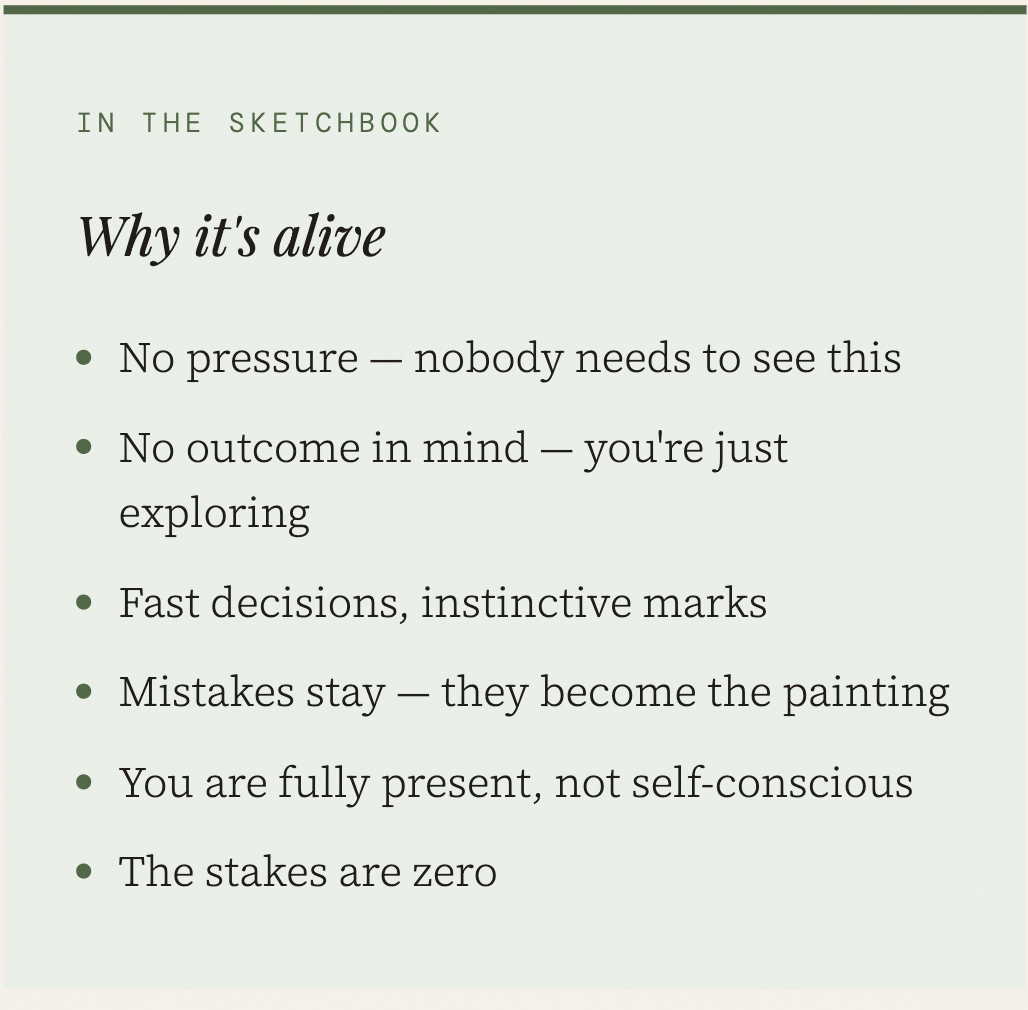
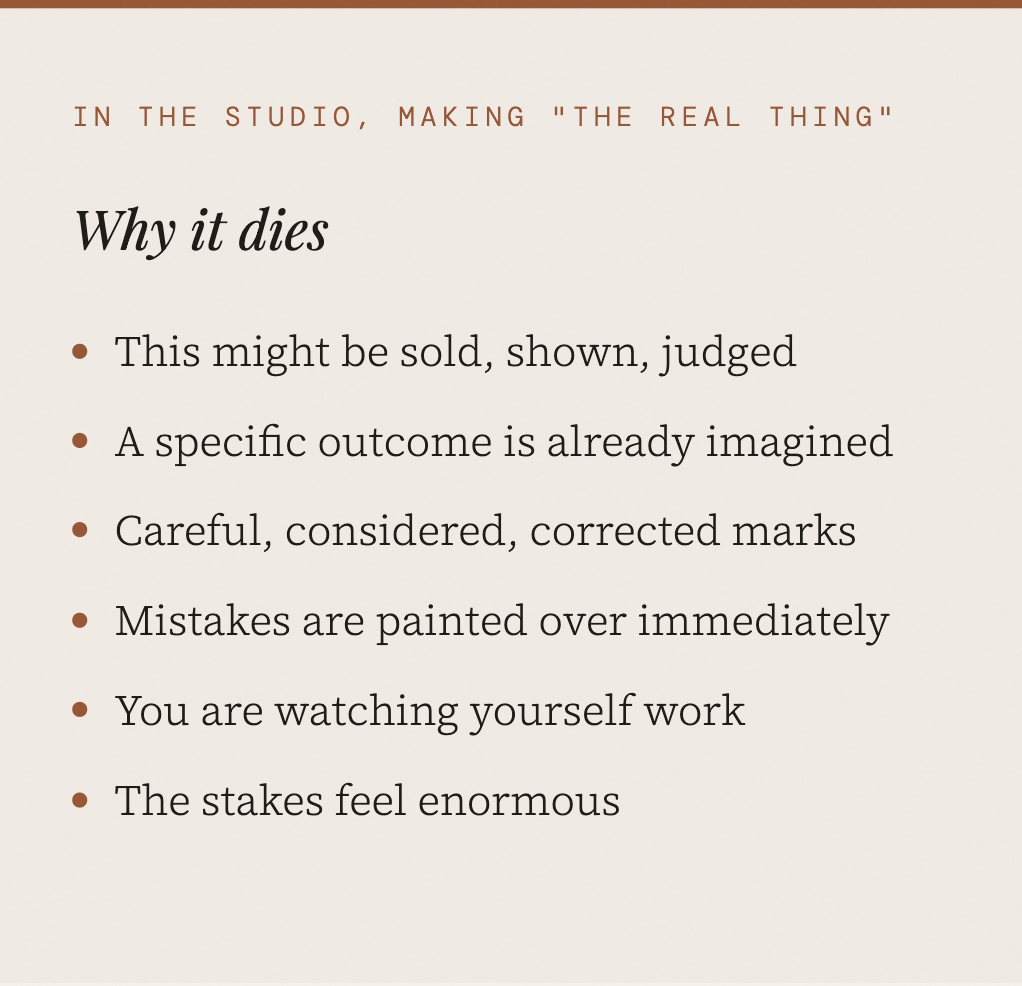
The moment something is designated as "a finished painting," the entire psychological contract changes. You shift from explorer to performer. And as we explored in Week 4 — you cannot explore and perform at the same time.
The answer isn't to try harder to be loose in the studio. Trying to be spontaneous is a contradiction in terms. The answer is to redesign the process so that the studio painting never feels like "the real thing" in the first place — so the stakes never spike, and the energy never dies.
Your final work isn't meant to be a copy of the sketch. It's meant to echo its sense of freedom and aliveness. That is a completely different goal — and it requires a completely different approach.
The core mindset shift
Treat your final paintings as large sketchbook studies. Not finished works. Not definitive statements. Large, generous, experimental studies — with exactly the same freedom and permission you bring to the sketchbook page. The size changes. The stakes do not rise.
The three-stage process — a complete learning framework
The key to keeping spontaneity alive from first mark to finished canvas is to work in multiples at every stage — never pinning everything on one precious piece.
Here is the exact three-stage process I use in my own practice, broken down.
Stage One — Outdoors
Fast and Many: Gather your raw material
Your outdoor sessions are not about making good studies. They are about gathering visual intelligence — colour, composition, scale, texture, the quality of light — as quickly and as richly as possible. Think of yourself as a visual journalist rather than a painter. You are gathering material to work from later, not producing finished work now.
Stage Two — The Studio, First Session
Crop and Curate: Find the paintings within the studies
This is the stage most artists skip entirely — and it makes an enormous difference. Before you touch a fresh canvas, spend a dedicated session editing your outdoor work. This separates the gathering from the making, and gives you clarity about what you actually have.
Stage Three — The Studio, Making Session
Studies Become New Inspiration: Paint freely from your wall
Now — and only now — do you move to larger work. But even here, the mindset stays the same. Your edited studies on the wall are not instructions. They are inspiration. You are not trying to reproduce them at larger scale. You are using them as a jumping-off point for something new.
Why this process protects the energy
The three reasons spontaneity survives all the way to the finished canvas
The pressure is spread across multiples. At no stage does everything depend on a single piece. Outdoors: many studies. Editing: many crops. Studio: many large works. No single canvas carries the weight of everything.
Each stage has its own distinct purpose. Gathering is not making. Editing is not painting. Making is not copying. By separating these three things clearly, you never mix the anxiety of "finishing" with the freedom of "exploring."
The final canvas never feels like the only canvas. When you have five large studies on the go simultaneously, none of them becomes precious. The sketchbook energy transfers because the sketchbook mindset transfers with it.
You are always working from abundance. Rich outdoor material → curated, exciting crops → large canvases made with confidence. At every stage you have more to draw from than you need. Scarcity creates anxiety. Abundance creates freedom.
Six weeks · Six challenges · One Journey
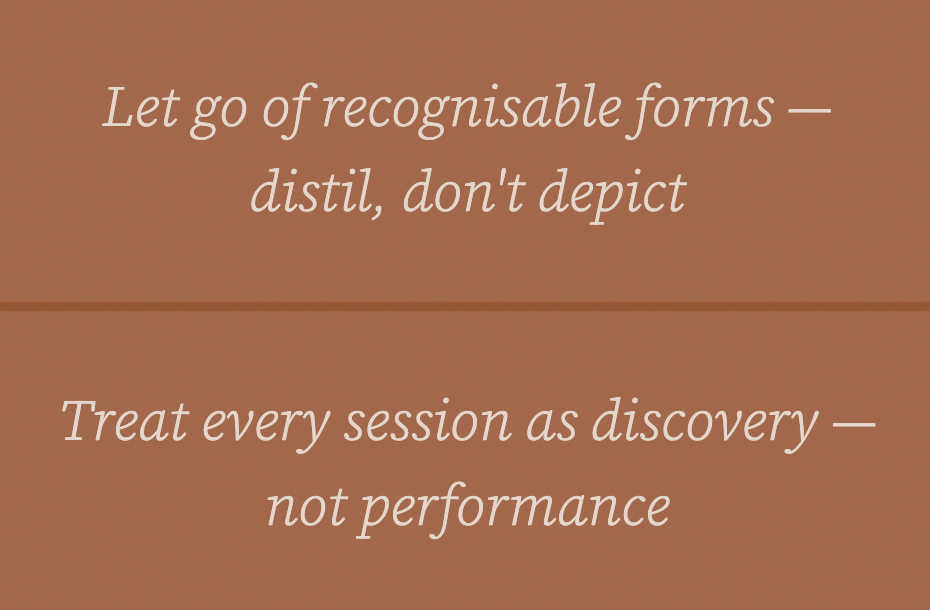
None of these things require talent you don't have. They require permission you haven't yet given yourself. Consider this series your permission slip.
What a journey this has been. It’s been amazing to write these blog posts for you. I hope they can be of great inspiration.
If you want to reach out to me you can do so here:
I hope something in this series has shifted something — even slightly — in how you approach the work.
If you feel ready for it, and have basic landscape painting skills, maybe my membership will be the perfect place for you!
All the ideas we’ve discussed in this blog series is what we cover inside the membership. Plus so much more. We have a new project every month, and we all LOVE abstraction! We are all learning together. Come and join us.
Wild at Art is an online membership for artists passionate about the landscape.
You can find the link below. You can join and see how you feel. It’s cancel at any time. If its not right for you, no problem. You’ll still learn loads.
Hope to see you in there!!
Love Sam xx